
by.U App
by.U App
by.U App
Mobile telecommunications case study
Mobile telecommunications case study
Mobile telecommunications case study
From Indonesia, powered by telkomsel
From Indonesia, powered by telkomsel
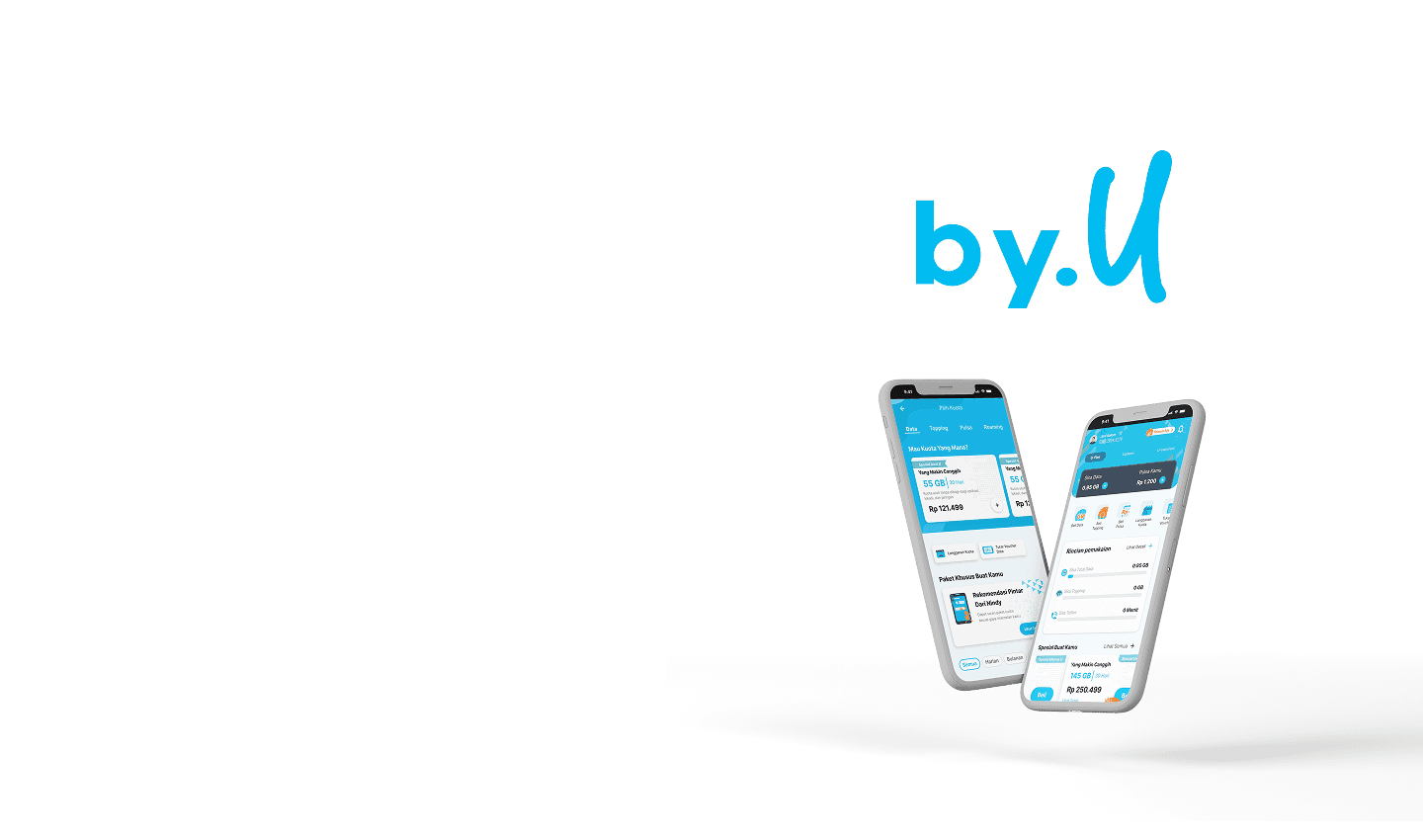
By.U is one of Telkomsel's digital products that offers application-based mobile services. Unlike traditional prepaid services, by.U gives users full flexibility to choose data packages, app quotas, and add-ons independently through the app. The concept focuses on freedom of customization and ease of use, thus targeting the younger generation who are digital-savvy and want full control over their internet needs.
By.U is one of Telkomsel's digital products that offers application-based mobile services. Unlike traditional prepaid services, by.U gives users full flexibility to choose data packages, app quotas, and add-ons independently through the app. The concept focuses on freedom of customization and ease of use, thus targeting the younger generation who are digital-savvy and want full control over their internet needs.
Role
Role
UI/UX Designer (Full Stack)
UI/UX Designer (Full Stack)
Duration
Duration
August 2025 (1 Month)
August 2025 (1 Month)
Objective
Objective
By.U is one of Telkomsel's digital products that offers application-based mobile services. Unlike traditional prepaid services, by.U gives users full flexibility to choose data packages, app quotas, and add-ons independently through the app. The concept focuses on freedom of customization and ease of use, thus targeting the younger generation who are digital-savvy and want full control over their internet needs.
By.U is one of Telkomsel's digital products that offers application-based mobile services. Unlike traditional prepaid services, by.U gives users full flexibility to choose data packages, app quotas, and add-ons independently through the app. The concept focuses on freedom of customization and ease of use, thus targeting the younger generation who are digital-savvy and want full control over their internet needs.
Problem statement
Problem statement
The custom settings feature is rarely used because users don't find any immediate benefit → it's too complicated.
The custom settings feature is rarely used because users don't find any immediate benefit → it's too complicated.
“Users have difficulty making decisions when choosing a quota, making the experience feel less efficient.”
“Users have difficulty making decisions when choosing a quota, making the experience feel less efficient.”


Goal evaluation
Goal evaluation
Measure whether the addition of usage tracking + package recommendation is possible:
Measure whether the addition of usage tracking + package recommendation is possible:
Make the feature more useful (usefulness)
Make the feature more useful (usefulness)
Easier to understand & use (usability)
Easier to understand & use (usability)
More favorable to users (desirability)
More favorable to users (desirability)
Survey
Survey
Measure whether the addition of usage tracking + package recommendation is possible:
Measure whether the addition of usage tracking + package recommendation is possible:
5 respondents by.U user main target
5 respondents by.U user main target
18−25 years old
18−25 years old
Male and female
Male and female
Residing in Indonesia
Residing in Indonesia
Insight
Insight
Value for money is the main factor
Value for money is the main factor
The recommendation feature is very relevant
The recommendation feature is very relevant
Quota management is important
Quota management is important
Feature “Atur Kuota Sendiri” needs to be optimized
Feature “Atur Kuota Sendiri” needs to be optimized
User flow
User flow
Data Usage Tracking
Data Usage Tracking
User Analytics & Categories
User Analytics & Categories
Generate Recommendations
Generate Recommendations
User Decision
User Decision
Feedback & Repeat
Feedback & Repeat






Wireframe
Wireframe
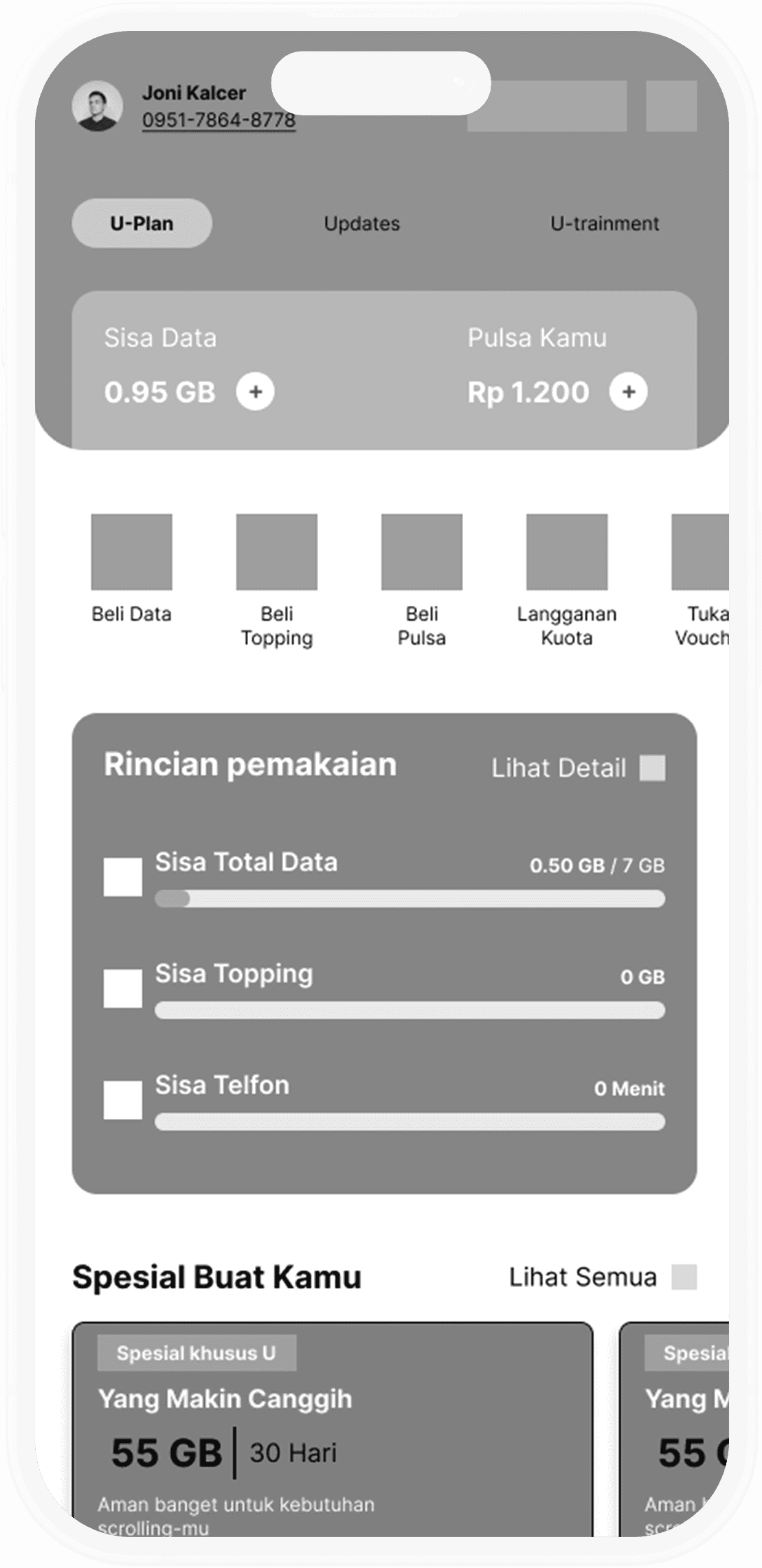
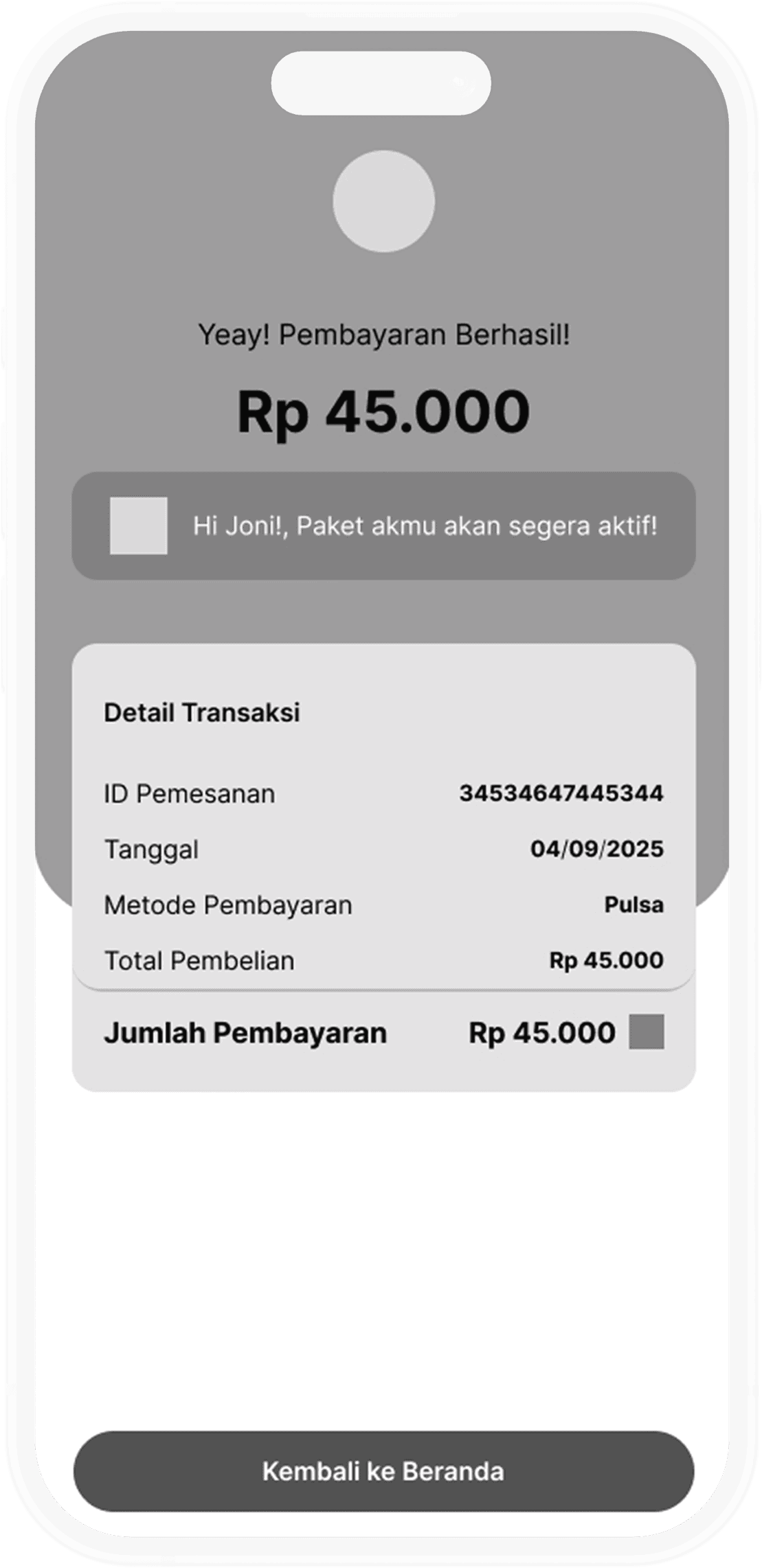
I chose to skip the traditional sketching phase and directly built the wireframes using Figma. For me, this method is more efficient and allows faster iteration and adjustment. It also helps me visualize layout, spacing, and structure more accurately from the start.
I chose to skip the traditional sketching phase and directly built the wireframes using Figma. For me, this method is more efficient and allows faster iteration and adjustment. It also helps me visualize layout, spacing, and structure more accurately from the start.
High-fidelity
High-fidelity
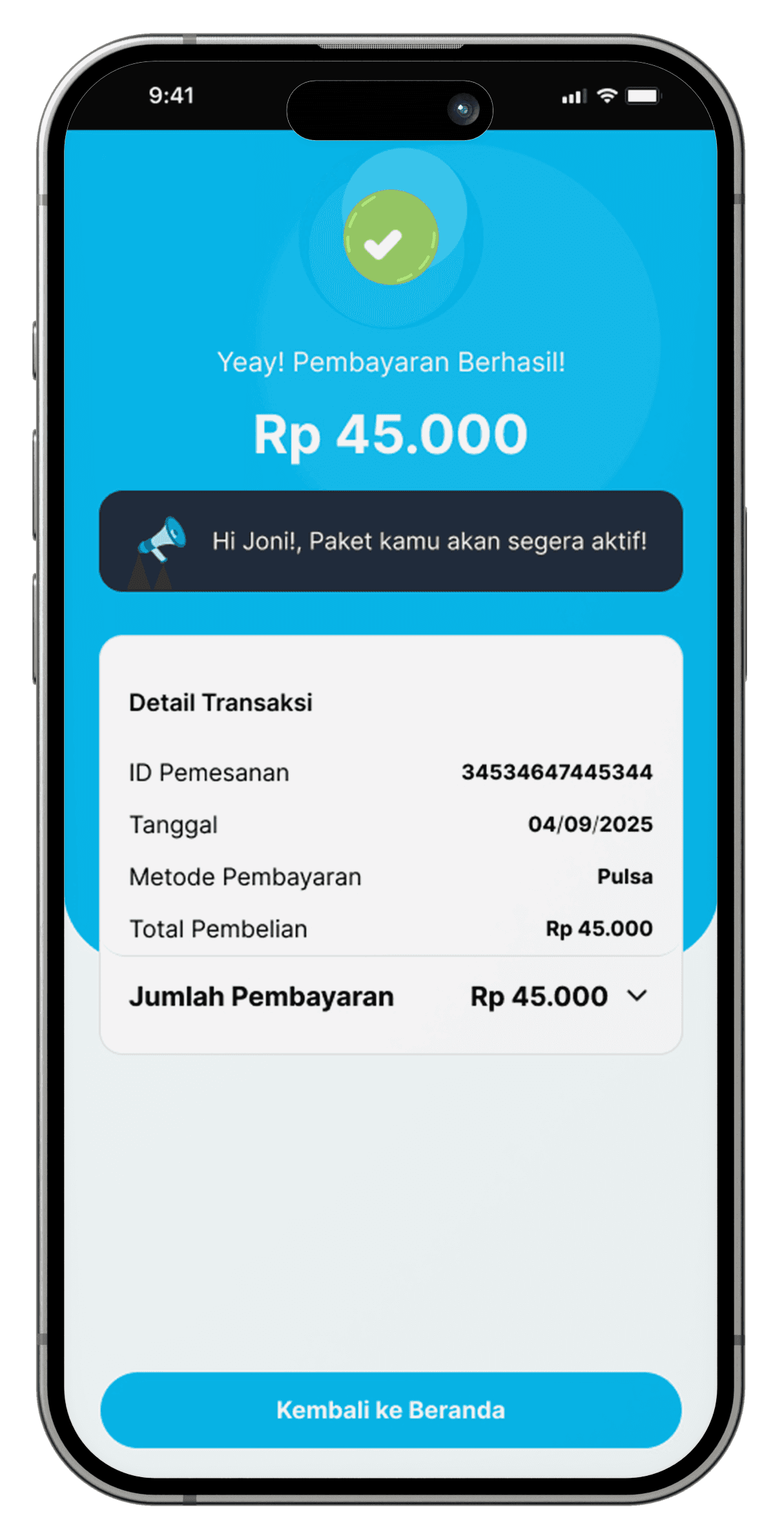
This high-fidelity prototype maintains the original style guide and colors of the by.U. app. Based on the research findings, the existing visuals already provide a user-friendly and accessible experience. Therefore, my iteration focused on enhancing features to support user needs, without changing the already strong design identity.
This high-fidelity prototype maintains the original style guide and colors of the by.U. app. Based on the research findings, the existing visuals already provide a user-friendly and accessible experience. Therefore, my iteration focused on enhancing features to support user needs, without changing the already strong design identity.




Usability test
Usability test
Usability testing to 6 respondents, consisting of 4 active users of by.U and 2 non-users

Test scenario
Test scenario
Users look for automatic package recommendations based on usage history
Users look for automatic package recommendations based on usage history
User tries to change the package (increase/decrease quota)
User tries to change the package (increase/decrease quota)
User completes the purchase of the package that has been arranged
User completes the purchase of the package that has been arranged
Users give feedback about the experience
Users give feedback about the experience



Insight testing
Insight testing
Usefulness / satisfaction data (from questionnaire)
Usefulness / satisfaction data (from questionnaire)
Usefulness (does the feature help you choose a package?)
Usefulness (does the feature help you choose a package?)
(8 + 10 + 9 + 7 + 8 + 10) ÷ 6 = 8.67
(8 + 10 + 9 + 7 + 8 + 10) ÷ 6 = 8.67
Satisfaction (how satisfied are you with the feature?)
Satisfaction (how satisfied are you with the feature?)
(8 + 9 + 10 + 7 + 8 + 8) ÷ 6 = 8.33
(8 + 9 + 10 + 7 + 8 + 8) ÷ 6 = 8.33
Intention to reuse (likelihood of reuse)
Intention to reuse (likelihood of reuse)
(6 + 8 + 8 + 6 + 9 + 9) ÷ 6 = 7.67
(6 + 8 + 8 + 6 + 9 + 9) ÷ 6 = 7.67
Numerically, the usability test results were good (100% success, score >8 for usefulness & satisfaction)
Numerically, the usability test results were good (100% success, score >8 for usefulness & satisfaction)
In terms of feedback, insights are important for improvement:
In terms of feedback, insights are important for improvement:
Package clarity & consistency
Package clarity & consistency
Placement of features on the homepage/top
Placement of features on the homepage/top

Analyze to EvalignUX
Analyze to EvalignUX
Average & gap analysis (current vs future state)
Average & gap analysis (current vs future state)
Current state (the “Atur Semua Semaunya” feature now)
Current state (the “Atur Semua Semaunya” feature now)
Usefulness → users feel quite flexible, but need more effort to explore the package.
Usefulness → users feel quite flexible, but need more effort to explore the package.
Satisfaction → standard, many say it's just "enough".
Satisfaction → standard, many say it's just "enough".
Intention to reuse → moderate (because the user has to think for themselves, there is no recommendation assistance).
Intention to reuse → moderate (because the user has to think for themselves, there is no recommendation assistance).
Future state (with recommendations + tracking features)
Future state (with recommendations + tracking features)
Usefulness = 8.67
Usefulness = 8.67
Satisfaction = 8.33
Satisfaction = 8.33
Intention to Reuse = 7.67
Intention to Reuse = 7.67
Gap (future – current)
Gap (future – current)
Usefulness → significantly increased (future state is more helpful).
Usefulness → significantly increased (future state is more helpful).
Satisfaction → increased, because the package is clearer.
Satisfaction → increased, because the package is clearer.
Intention → increased, but there are still barriers (e.g. other packages already exist, or need consistency of recommendations).
Intention → increased, but there are still barriers (e.g. other packages already exist, or need consistency of recommendations).
Pain points
Pain points
Additional Information → Some users requested a reminder feature so that they don't forget the package expiration date.
Additional Information → Some users requested a reminder feature so that they don't forget the package expiration date.
Feature Placement → There are suggestions for recommendations to appear more upfront (e.g. on the homepage or top position).
Feature Placement → There are suggestions for recommendations to appear more upfront (e.g. on the homepage or top position).
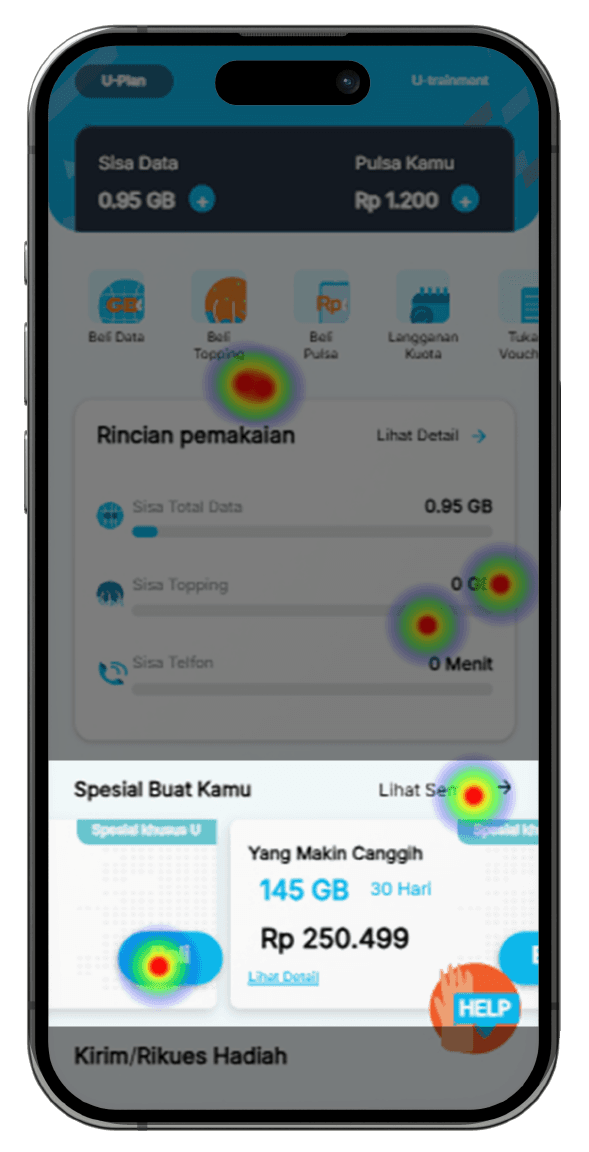
Minor Errors → The heatmap shows that there are misclicks in the recommendation button area (about 15%).
Minor Errors → The heatmap shows that there are misclicks in the recommendation button area (about 15%).
Strengths
Strengths
Easy to Understand → the majority said it was "easy/quite easy" to understand the package.
Easy to Understand → the majority said it was "easy/quite easy" to understand the package.
Clarity → package & quota information was rated as clear by almost all participants.
Clarity → package & quota information was rated as clear by almost all participants.
Attractive → The display is quite interesting, especially since the new features provoke curiosity.
Attractive → The display is quite interesting, especially since the new features provoke curiosity.
Time Saving → recommendations make it faster for users to find a suitable package.
Time Saving → recommendations make it faster for users to find a suitable package.
Evaluation conclusion
Evaluation conclusion
Usability → Solid
Usability → Solid
Usefulness → High
Usefulness → High
Desirability → Moderate
Desirability → Moderate
A future state with recommendations is superior to the current state → especially in terms of usefulness and efficiency. The main challenge is desirability (how to keep users engaged and engaged).
A future state with recommendations is superior to the current state → especially in terms of usefulness and efficiency. The main challenge is desirability (how to keep users engaged and engaged).
Recommendations
Recommendations
Based on the heatmap analysis, it was found that 3 out of 6 participants misclicked on the home page. Instead of following the proper flow to find and use the recommendation feature, they often clicked on the bottom area of the page in the "Spesial Buat Kamu" section.
Based on the heatmap analysis, it was found that 3 out of 6 participants misclicked on the home page. Instead of following the proper flow to find and use the recommendation feature, they often clicked on the bottom area of the page in the "Spesial Buat Kamu" section.
To reduce confusion and simplify navigation, it is recommended to swap positions
To reduce confusion and simplify navigation, it is recommended to swap positions



Iteration
Iteration
Before
Before
After
After


The goal is to increase the visibility of the recommendation feature, adapt to user interaction patterns, and minimize the occurrence of similar misclicks
The goal is to increase the visibility of the recommendation feature, adapt to user interaction patterns, and minimize the occurrence of similar misclicks

Final design
Final design


Coclusion & reflection
Coclusion & reflection
Through this case study, I learned that using the right structure greatly facilitates the design process. The biggest challenge I faced was the lack of efficiency in the “Atur Semua Semaunya" feature in the by.U app. Although the solution I developed was not perfect, the recommendation feature succeeded in providing additional support for users in choosing quota packages in less time than before. This project emphasizes the importance of empathy-driven design and continuous iteration as key to delivering relevant and useful solutions to users.
Through this case study, I learned that using the right structure greatly facilitates the design process. The biggest challenge I faced was the lack of efficiency in the “Atur Semua Semaunya" feature in the by.U app. Although the solution I developed was not perfect, the recommendation feature succeeded in providing additional support for users in choosing quota packages in less time than before. This project emphasizes the importance of empathy-driven design and continuous iteration as key to delivering relevant and useful solutions to users.
let’s
let’s
let’s
collaborate
collaborate
collaborate
good collaboration will bring rapid progress in the future
good collaboration will bring rapid progress in the future